What the ICJ decided
The case, The Gambia v. Myanmar, was filed in 2019 with the backing of the Organisation of Islamic Cooperation. It concerned the Myanmar army’s 2016–2017 “clearance operations” in northern Rakhine State. By nine votes to six, the judges found that:
- Myanmar committed genocide against the Rohingya.
- Myanmar failed to investigate and punish those responsible.
- Myanmar failed to prevent the destruction of evidence.
On one point the Court sided with Myanmar: it did not find that the state directly and publicly incited genocide by private individuals.
Myanmar argued that the army was fighting an armed group. The Court’s answer, as I understand it, was that a military goal and an intent to destroy a people can exist side by side. One does not cancel the other.
The ruling is final and cannot be appealed. But the Court has no way to enforce it.
What I photographed in Cox’s Bazar
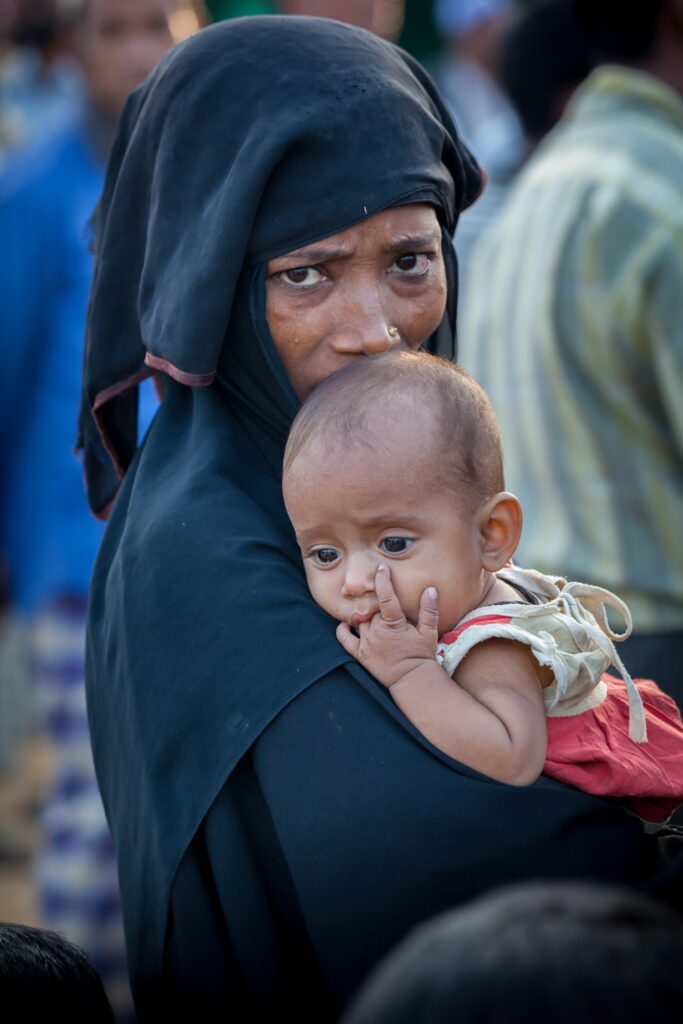
In about two and a half months in 2017, more than 700,000 Rohingya fled across the Naf River into Bangladesh. When I got to the camps, they were still being built. Hillsides were covered in bamboo frames and plastic sheeting, and new shelters went up every day.
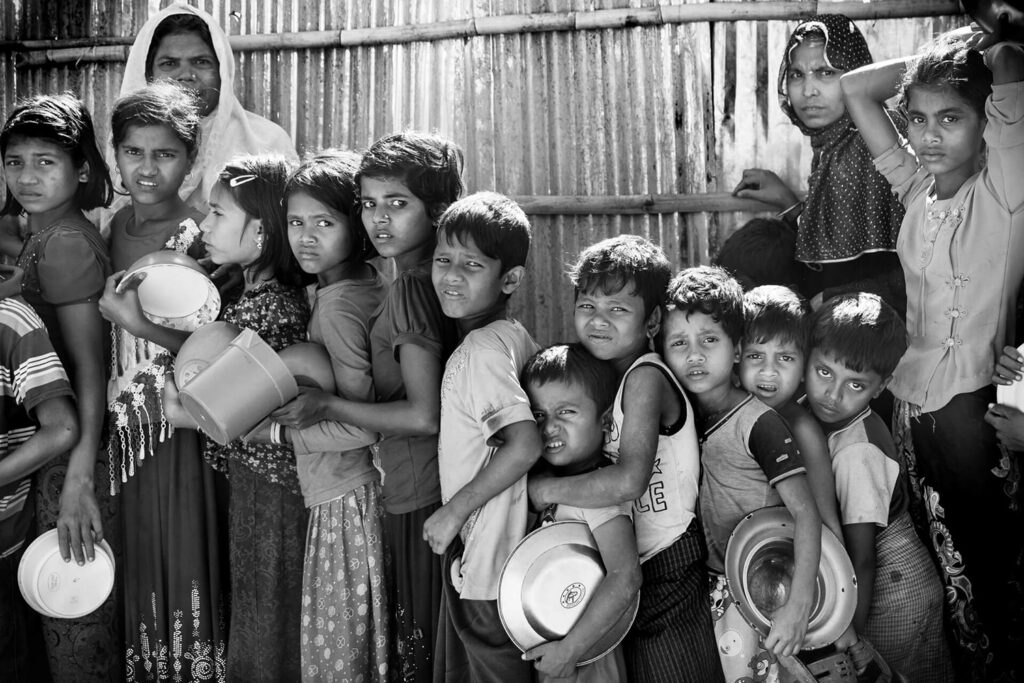
The first thing you notice is the waiting. Children lined up against corrugated walls holding plastic bowls. Men pressed against bamboo fences with ration tokens in their raised hands. Women stood in line behind stacks of rice sacks. Almost everything depended on a queue, a token or a list.
The second thing you notice is that people don’t stop living. Two men sat on the ground weaving bamboo walls by hand. A barber worked in a shed of green corrugated sheets, his customer’s face covered in shaving cream. Children ran, played, carried water. On one tarpaulin wall someone had written “Verified by RIC” in red marker.

That little label stayed with me. These were people whose citizenship had been taken away at home. Here, their shelters were being “verified”.
What documentary photography can and can’t do
When Gambia first argued its case in The Hague in December 2019, its lawyers showed the judges maps, satellite images and photographs. Images were part of how the world came to understand what had happened in Rakhine.
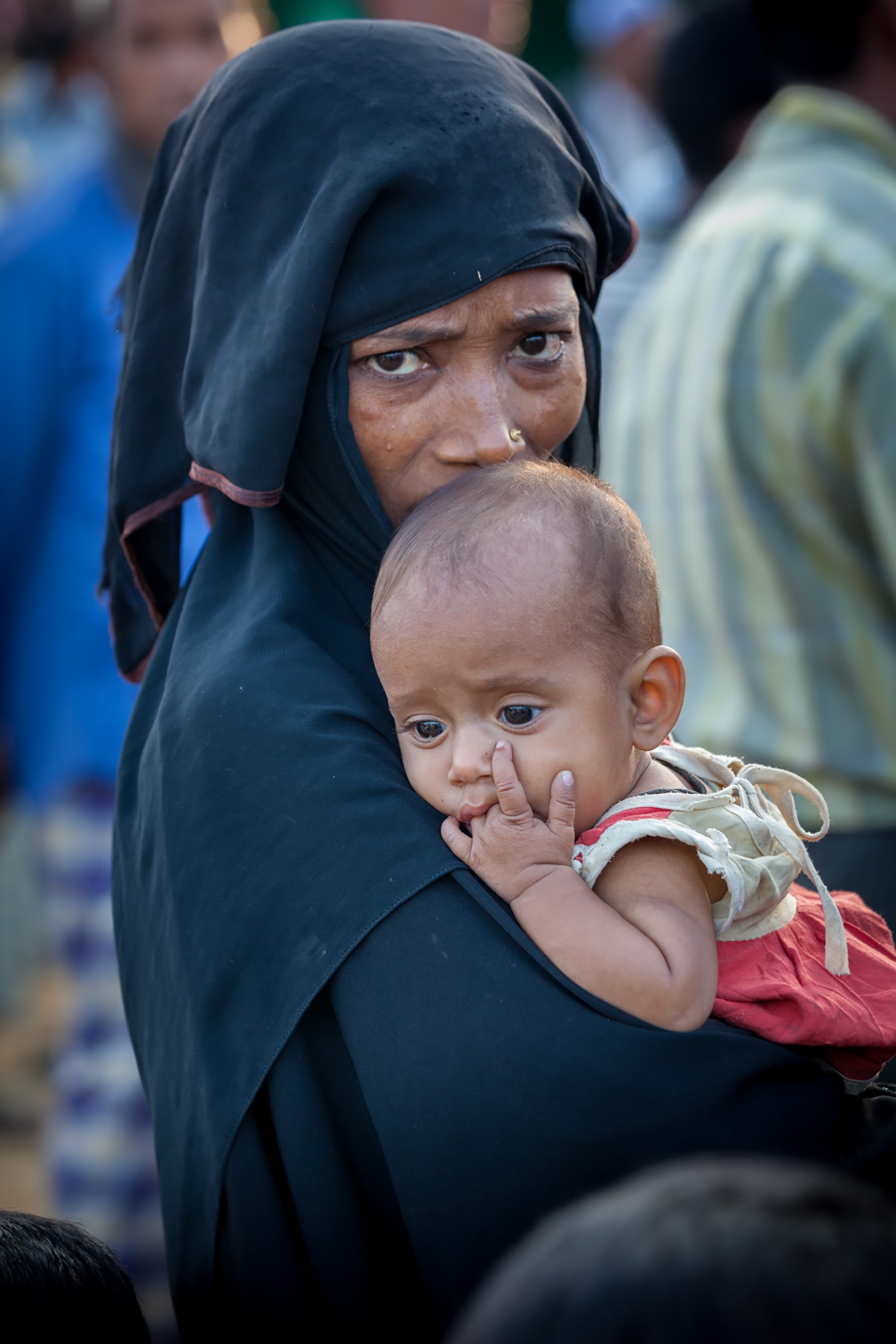
My Rohingya photographs were never evidence. I wasn’t in Rakhine when the villages burned. I arrived afterwards, in the camps, where the consequences were living, breathing and waiting in line. That is a different kind of record. It doesn’t prove intent. It shows what is left when a people is pushed out of its own country.
I think that is still worth something. It is what documentary photography does best. A court ruling is written in the language of law: findings, votes, obligations. Photographs speak another language. They remind us that “the Rohingya” is not a legal category but a grandmother, a barber, a girl peeking out from behind a tarp.

Where things stand now
The camps I photographed as an emergency are now nine years old. According to UNHCR, about 1.2 million Rohingya refugees live in Bangladesh today, most of them in 33 crowded camps in Cox’s Bazar. Inside Myanmar, around 550,000 Rohingya remain, many caught between the military and the Arakan Army.
The ruling won’t change any of that overnight. It can’t open a border or rebuild a village. What it does is settle a question that survivors have been forced to argue about for years. What happened in 2017 has a name now, and a responsible state.
If you’d like to know more about who the Rohingya are and why they became stateless, I’ve updated my photo story The Rohingyas: Stateless & Identityless, with more photographs from the camps.
I don’t know where most of the people in my photographs are today. Many of the children are probably young adults now, and most of their lives have been spent in those camps. I hope the ruling means something to them. I hope it doesn’t become just another headline for the rest of us.
Quick answers
Did the ICJ rule that the Rohingya genocide happened?
Yes. On 19 November 2026, by nine votes to six, the International Court of Justice found Myanmar responsible for genocide against the Rohingya during the 2016–2017 military operations in Rakhine State. It was the first time the Court found a state guilty of genocide.
Who brought the case against Myanmar?
The Gambia, in 2019, with the support of the Organisation of Islamic Cooperation.
Can the ruling be enforced?
The judgment is final and binding, and Myanmar cannot appeal. But the ICJ has no power to enforce it on its own.
How many Rohingya refugees live in Bangladesh?
About 1.2 million as of September 2026, according to UNHCR, most of them in the camps of Cox’s Bazar.
About the photographer
Enis Yücel is a documentary photographer and visual storyteller. His long-form photo stories follow people living through displacement, memory and tradition, from the Rohingya refugee camps in Bangladesh to Syrian refugees learning to walk again and the Day of the Dead in Oaxaca, Mexico. He also leads photography tours and workshops for photographers who want to tell stories with their images.
Sources
- International Court of Justice: The Gambia v. Myanmar (case page)
- Human Rights Watch: World Court Finds Myanmar Committed Rohingya Genocide
- The Conversation: A seismic ICJ ruling has found Myanmar responsible for genocide
- The Hill: UN court rules that Myanmar committed genocide against Rohingya
- Foreign Policy: ICJ to Deliver Landmark Verdict on Myanmar
- CBS News: U.N. orders Myanmar to prevent Rohingya genocide (2020)
- UNHCR: Myanmar situation data
- UNHCR Bangladesh: Operational overview
- AP via La Nación: Top UN court to deliver judgment in Myanmar genocide case